
By the WSIADA Compliance & Member Protection Division
For independent automobile dealers across Washington State, financing and spot-delivery decisions carry real financial risk. Even when a deal passes automated credit checks and initial lender stipulation reviews, sophisticated fraud rings are increasingly exploiting synthetic identities, altered Social Security cards, and forged supporting documents to drive high-value vehicles off dealership lots—leaving stores exposed to devastating lender repurchase demands.
Following recent reports of suspected identity and document fraud affecting Washington dealerships and local credit unions, WSIADA is issuing this comprehensive guide to help dealers, finance managers, and title clerks spot the warning signs of synthetic identity fraud, understand the illegal "Credit Privacy Number" (CPN) marketplace fueling these schemes, and establish strict verification protocols before releasing keys.
Important Investigative Advisory
Please note: The case details outlined below are shared strictly for dealership verification, risk management, and loss prevention purposes. They represent suspected fraud indicators currently under active law enforcement investigation and do not constitute a determination of criminal guilt.
A Wake-Up Call for Washington Dealerships: When Automated Checks Aren’t Enough
Recently, a member dealership recovered a Tesla after the financing credit union (WECU) identified the funded application as fraudulent and issued a repurchase demand. Similar vehicle purchases involving overlapping patterns were reported across other Washington dealerships and credit unions, and the matter has been referred to law enforcement detectives actively investigating the suspected network.
The most alarming takeaway for dealership finance departments is how easily these transactions can slip past standard front-end screening. In the reported case, the transaction initially passed automated identity checks and lender review of both income and driver-license documents prior to funding. Only after deeper forensic inspection and post-funding scrutiny did the underlying fraud emerge.
Case-Specific Document & Credit Red Flags
When reviewing deals—especially high-dollar or remote transactions—dealership staff should look closely at the following anomalies uncovered in these submissions:
Reused and Altered Social Security Card Images: In two separate submissions tied to the investigation (submitted roughly five weeks apart in October and November 2026), the front images of the Social Security cards displayed different names and numbers. However, forensic examination of the reverse sides revealed that both submissions reused the exact same underlying photograph—complete with identical background marks and surface reflections—merely cropped with different framing and resolution. Furthermore, both cards exhibited inconsistencies between the printed issuance date on the front and the physical security design on the reverse.
Synthetic Credit File Indicators: The credit profile displayed classic hallmarks of a fabricated or "built" credit identity: a recently established credit file, a single high-limit authorized-user (AU) tradeline, a burst of recent credit inquiries, multiple differing residential addresses, and conflicting income or housing figures across successive versions of the credit application.
While none of these indicators proves fraud in isolation, together they form a clear pattern that demands manual human verification before a vehicle leaves your lot.
Inside the Online "CPN" Synthetic Identity Marketplace
To understand why these altered documents and thin-but-high-scoring credit files are appearing in dealership finance offices, dealers need to understand the thriving underground marketplace for Credit Privacy Numbers (CPNs) sold openly on social media platforms.
Fraudulent "credit repair" and synthetic identity brokers advertise tiered packages—typically ranging from $200 to $500, plus paid add-ons—promising individuals with damaged credit, prior evictions, or criminal backgrounds a "clean slate" to get approved for auto loans, apartments, and credit cards.
When a buyer purchases one of these packages, they are buying a step-by-step toolkit for financial fraud:
CPN (Credit Privacy Number): Sellers provide a nine-digit number formatted identically to a Social Security Number. In reality, these numbers are either algorithmically generated or—far worse—stolen SSNs belonging to children, senior citizens, or deceased individuals whose credit files are dormant.
Tri-Merged / Blank Profile Setup: The package includes instructions on how to attach the CPN to the buyer’s real name, date of birth, and a newly established mailing address across the three major credit bureaus (Equifax, Experian, and TransUnion) to trigger the creation of a brand-new, blank credit file.
Authorized User (AU) Tradelines ($150+): A blank credit file will not qualify for prime auto financing on its own. To artificially inflate the score (often advertising guaranteed scores of "640+"), brokers pay third parties with aged, high-limit credit cards to temporarily add the buyer’s synthetic profile as an authorized user. Once the tradeline reports, the synthetic profile suddenly appears creditworthy.
Forged Supporting Documents: Higher-tier packages and add-on menus explicitly supply counterfeit stipulation documents tailored to pass lender verification, including fake pay stubs ("Proof of Income"), altered bank statements, fabricated utility bills, fake rental histories, and counterfeit driver’s licenses or state IDs ("Digital ID" or "Hardcopy ID/DL").
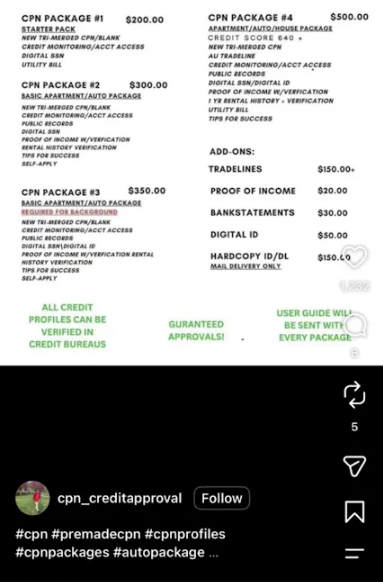
The Legal Reality: CPNs Are 100% Illegal
Sellers frequently market CPNs to consumers as a legal "privacy loophole" supposedly created for celebrities, judges, or politicians under the Privacy Act of 1974. This claim is completely false. The U.S. government does not issue Credit Privacy Numbers, and no legal substitute for a Social Security Number exists on a consumer credit or loan application.
Using a CPN, forged pay stubs, or a counterfeit driver’s license to obtain an auto loan is not a "gray area"—it is a serious crime carrying severe state and federal penalties, including:
Synthetic Identity Theft (particularly when the number belongs to a minor or senior citizen)
Bank Fraud and Wire Fraud
Making False Statements on a Loan or Credit Application (a federal felony under 18 U.S.C. § 1014)
Forgery and Possession of Counterfeit Identification
Dealership Action Plan: Verification & Evidence Preservation
Because automated underwriting tools can be fooled by freshly tri-merged CPN files and high-resolution digital forgeries, independent dealerships must serve as the first line of defense. WSIADA recommends implementing the following safeguards immediately:
1. Audit Every Detail of Identity & Income Documents
Inspect Both Sides of SSN Cards: Never accept a cropped, low-resolution, or front-only image of a Social Security card. Require clear, full-frame images of both the front and back, verify that lighting and background surfaces match between the two photos, and check that control numbers and reverse-side layouts align with the issuance date.
Verify Employment Independently: Do not call the phone number printed on a customer-supplied pay stub or listed on the credit application. Look up the employer independently through official state business registries or verified public directories to confirm employment and income.
Reconcile Application Changes: Whenever an applicant’s address, employer, housing payment, or gross income shifts between application drafts, pause the transaction and require documented proof explaining the discrepancy.
Request Lender-Approved SSN Verification: When a credit report shows a thin file anchored primarily by a single authorized-user tradeline and recent inquiries, coordinate directly with your lender’s underwriting or fraud team to run direct SSA/eCBSV verification before releasing the vehicle.
2. Preserve Records If You Suspect Fraud
If a suspect name or document pattern appears in your dealership’s transaction logs, review the underlying deal jacket thoroughly rather than assuming a name match alone proves involvement. If fraud is suspected:
Lock Down All Evidence: Preserve original emails, text messages, digital attachments (in their native file formats with metadata intact), every version of the credit application, lender portal comments, showroom or lot surveillance footage, wet or electronic signatures, and GPS/tracking records.
Notify Your Lender Immediately: Contact your lender’s dedicated fraud department right away to coordinate next steps and mitigate repurchase exposure.
Official Channels to Report Suspected Auto Loan Fraud
If your dealership uncovers suspected identity theft, synthetic CPN fraud, or forged loan documents, file a report with your local police department and submit official reports through both state and federal regulatory channels:
Washington State Department of Financial Institutions (DFI): https://dfi.wa.gov/10b/en/report
Federal Trade Commission (FTC) Fraud Assistant: https://reportfraud.ftc.gov/assistant
Note: An indexed evidence packet and supporting originals from the recent Washington case have been preserved and can be shared securely with law enforcement agencies and affected financial institutions.
Stay Vigilant, Stay Protected.
For additional compliance resources, audit checklists, and dealer protection updates, visit wsiada.com or contact the WSIADA Compliance & Education team at (253) 735-0267.
